EMMA - Environmental Modeling & Mechanics Analysis

See how a building fails, and who gets hurt, before the earthquake comes.

EMMA cuts a building into thousands of pieces joined by springs, shakes it, and follows every piece from the first crack to the rubble on the ground, with the people inside.

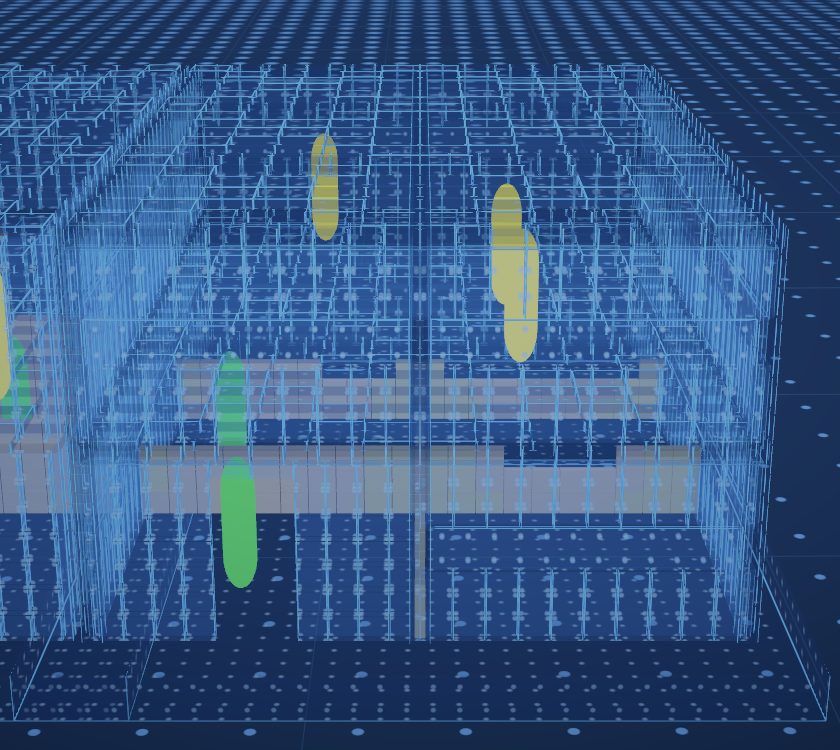
A four-storey concrete frame at 0.72 g in EMMA's review screen. On the right, everyone inside, graded as the floors come down: safe, injured, trapped or killed, with the cause.
3,247pieces in the building
165,920spring sets joining them
0.011 mstime step
16people followed, room by room
1 h 32 minto solve on one computer
The same engine

Other buildings, other events

The same solver takes several buildings at once, and blasts as well as earthquakes.

Three buildings on one site, 38 people

Two four-storey concrete frames and a three-storey one, side by side, shaken by an M7 earthquake set to 1.0 g. Neighbours sway into each other and fall separately, and each person is followed to where they end up.

3 buildings · 1,374 pieces · 38 people

Blast beside a building

The blast load is worked out for every piece of the facade. The crater is dug into the ground, panels are torn off and thrown, floors that lose their supports fall, and each person is graded by what hit them.

crater 9.8 m across, 1.6 m deep

How it works

From a floor plan to the rubble, in four steps

01

Build

Describe the building by storeys, bays, walls and materials, or import a model. Every wall, floor, column and roof is cut into pieces.

02

Shake

Choose a recorded earthquake, a synthetic one shaped for the site, or a blast. Place people in the rooms.

03

Solve

Touching pieces are joined by springs that crack, crush and slide (the applied element method). Pieces that break free fall, hit and pile up.

04

Review

Play the run forwards and backwards. See damage by colour, look through the walls, and read why each person was hurt, such as "crushed under the floor" or "trapped in a void".

The four steps in the application, in about a minute: configure the structure, set up the earthquake, place the people, simulate, and read the report.
Case study · Chupaca, Junín, Peru

Pumpunya, 18 July 2026

At 21:24 an M5.4 earthquake struck 7 km south of Chupaca. In Pumpunya, an annex of Chongos Bajo, about 90 % of the settlement was destroyed or left uninhabitable. Four of the six or seven people who died lived there, most in adobe houses.

Magnitude
M5.4 (IGP)
Depth
≈ 10 km
Recorded in Huancayo, 18 km away
0.05–0.07 g
Chongos Bajo homes
129 destroyed · 633 unsafe

One street, three ways to build, the same earthquake

We rebuilt a Pumpunya street in EMMA: three two-storey houses side by side, five people in each, shaken by the same ground. Each simulated house is shown next to a house of the same kind photographed after the earthquake.

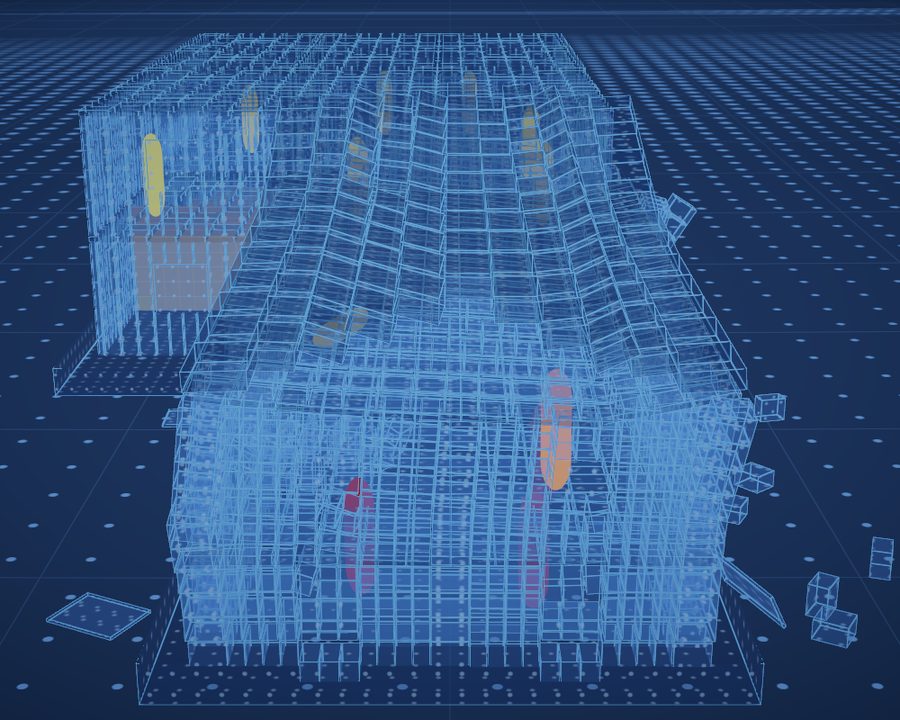
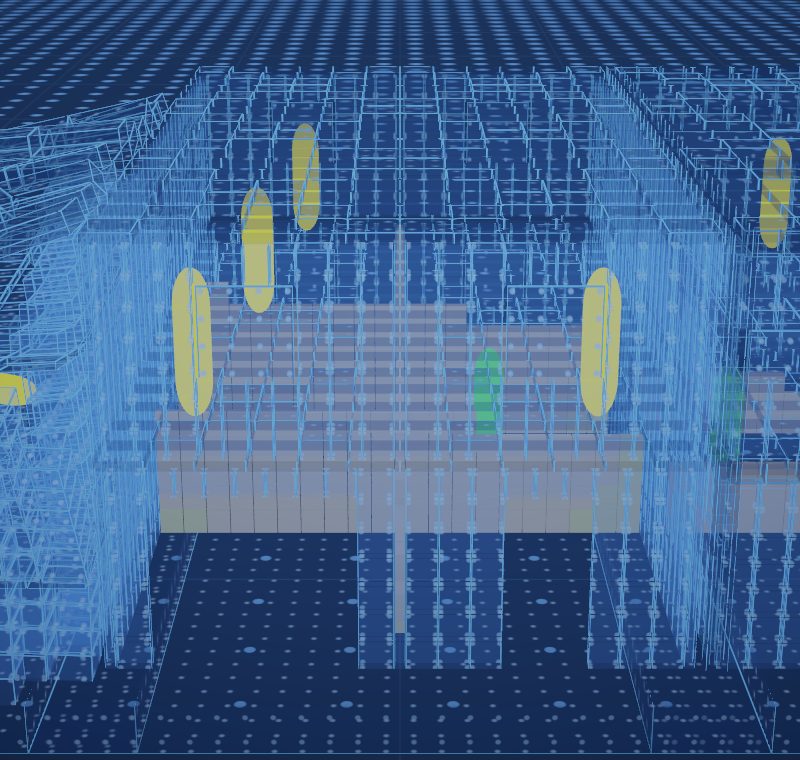
Simulated Pumpunya street before the earthquake: three two-storey houses, every person shown in green The same street after 12 seconds of shaking: the adobe house on the left has come down, the two brick houses stand BEFORE AFTER 12 s · 0.3 g
Pumpunya street in EMMA's transparent view. Drag across the picture to compare before and after. People are coloured by injury.

Adobe with a tiled roof

Old adobe walls 50 cm thick, corners butted rather than bonded, timber floors and a heavy tile roof resting on gables.

Collapsed · 3,075 of 3,104 pieces
People inside (5)
3 killed on the ground floor, crushed under the upper floor. 1 seriously hurt, buried. 1 trapped in a void 1.9 m high.
In Pumpunya
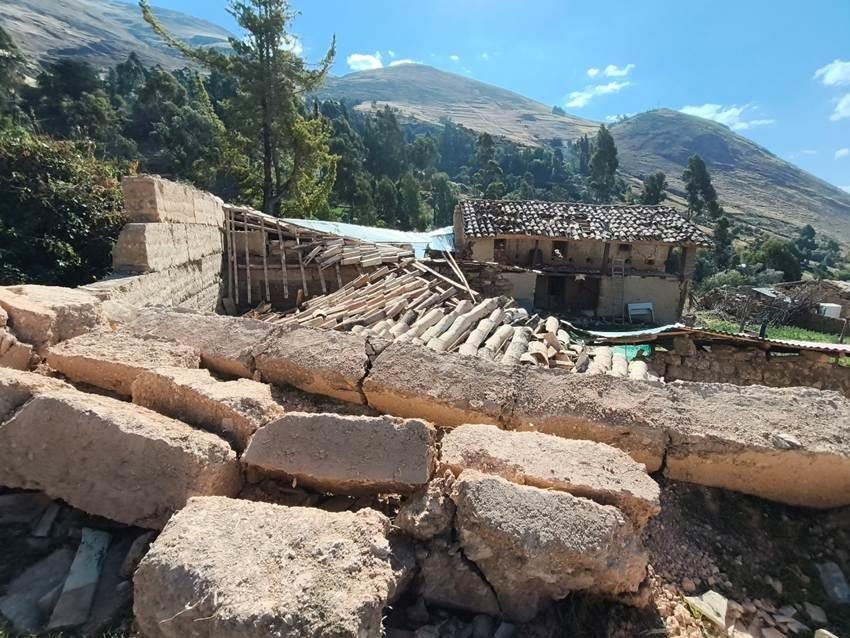
Adobe houses collapsed or were left unsafe to enter.
EMMA · 0.3 g
Simulated adobe house after the earthquake: the roof has dropped onto the ground floor; red figures inside
Pumpunya · CISMID-UNI
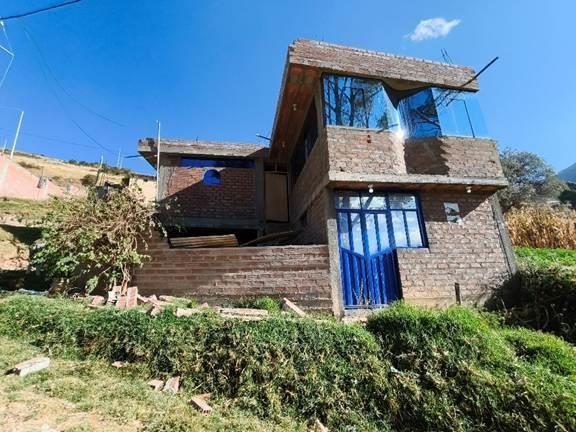
Collapsed adobe house in Pumpunya: walls fallen outward, tiled roof on the ground

Plain clay brick

Hand-made clay brick 13 cm thick, concrete floors, no concrete frame around the walls.

Standing · light cracks
People inside (5)
4 knocked down by the floor shaking, lightly hurt. 1 unharmed.
In Pumpunya
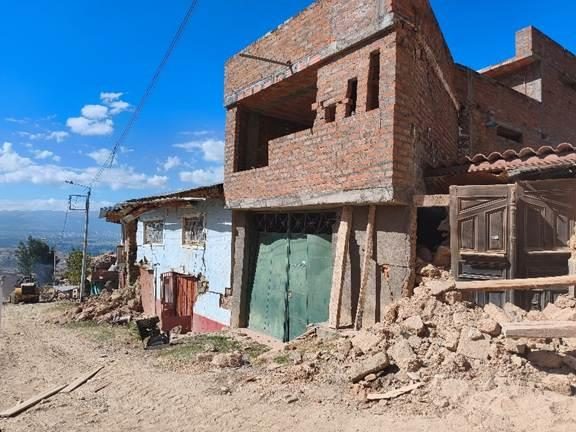
Cracked walls, held up with timber props, standing.
EMMA · 0.3 g
Simulated plain brick house after the earthquake, standing, people inside shown in yellow
Pumpunya · CISMID-UNI
Two-storey unconfined brick house in Pumpunya, cracked and propped

Confined brick

The same brick, built inside concrete tie columns and beams.

Standing · light cracks
People inside (5)
3 knocked down, lightly hurt. 2 unharmed.
In Pumpunya
No significant damage.
EMMA · 0.3 g
Simulated confined brick house after the earthquake, standing, people inside shown in green and yellow
Pumpunya · CISMID-UNI
Two-storey confined brick house in Pumpunya with no significant damage
The ground in all three runs: a synthetic record shaped like what CISMID measured, 12 s long and strongest at 6.7 Hz, the range where one- and two-storey adobe houses shake hardest.
ShakingAdobePlain brickConfined brickPeople
0.15 gestimated for Pumpunya from the recordings CollapseA few cracksA few cracks Adobe: 3 killed, 2 critical. Brick houses: all 10 unharmed.
0.3 gthe worst spots near the fault CollapseLight cracksLight cracks Adobe: 3 killed, 1 serious, 1 trapped. Brick houses: 7 lightly hurt, 3 unharmed.
0.6 gstronger than this earthquake CollapseMore crackingMore cracking Adobe: 4 killed, 1 serious. Brick houses: all 10 lightly hurt.
Checked against lab tests

Measured, and still being measured

  • UCSD shake tableThree-storey concrete frame with brick infill, 14 earthquakes up to collapsecollapses in the right storey
  • Colorado push tests (CU1, CU2)One-storey infilled frame pushed sideways, with and without a windowpeak 65–86 % of test
  • Beams and columnsCantilevers, fixed beams, concrete sections to first yield108.6 vs 108.5 kNm

Inputs are never tuned to make a test match. The model still errs toward the building surviving.

Where it fits

What EMMA is for

For

  • Comparing ways of building under the same earthquake
  • Showing where people get trapped, and where the voids are
  • Explaining to residents and officials why construction matters